Context
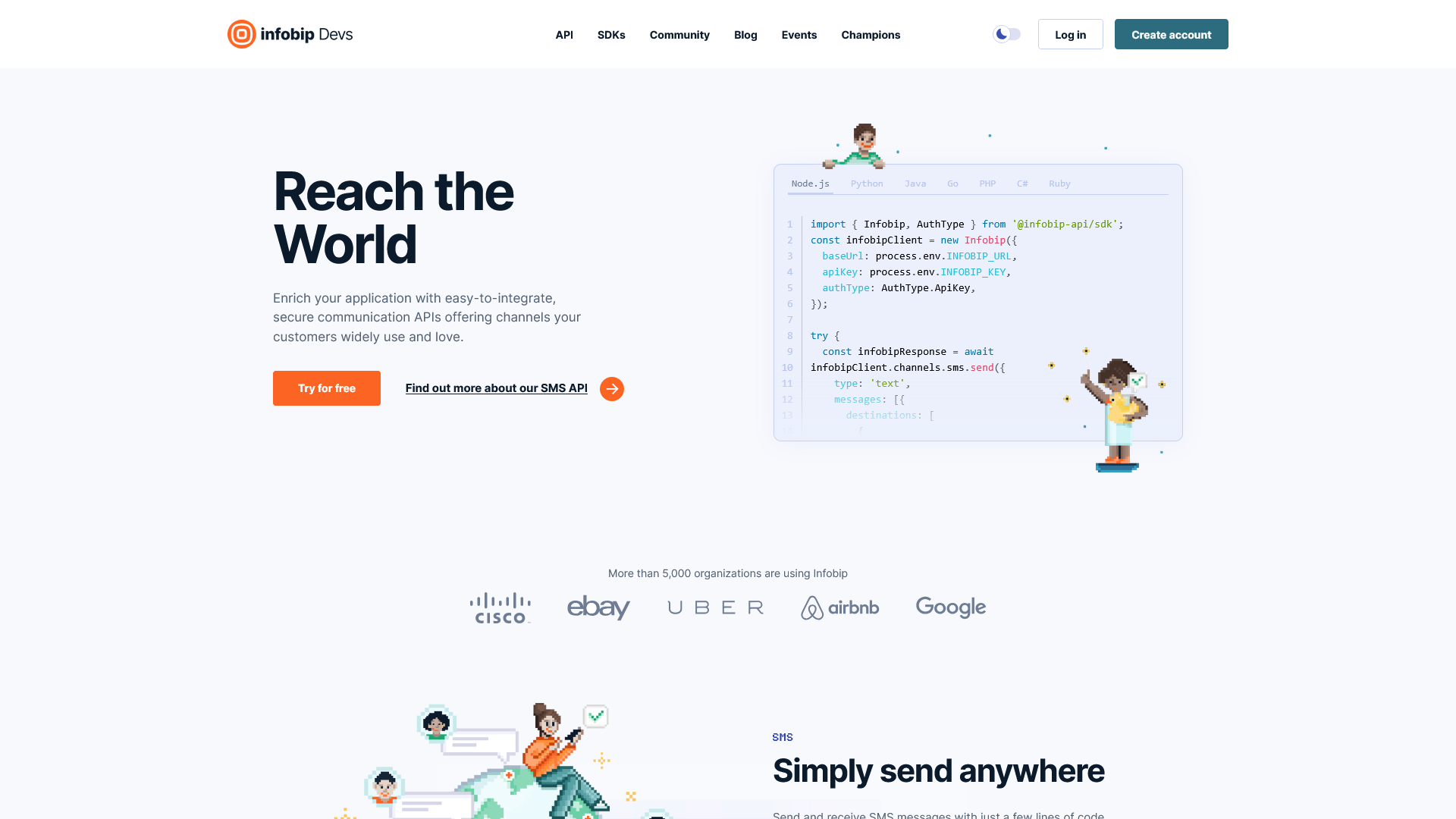
Infobip Developers Hub is a central access point for developers working with the Infobip platform. It serves a global audience that expects consistency, precision, and technical reliability.
The site is not a marketing presentation. It acts as an operational layer for documentation, events, and ongoing communication with the developer community.
In this environment, visual identity and technical implementation are not separate concerns. They form a single trust surface.
The actual problem
The challenge was not missing functionality. It was the requirement for implementation accuracy under continuous editorial use.
- The design was predefined and needed to be reproduced without drift.
- The system had to support frequent content updates.
- Managing events and publications could not require technical knowledge.
- The portal needed to remain stable over time, not just at launch.
In practical terms, the task was to reconcile strict design specifications with real editorial workflows without introducing fragility.
Constraints and trade-offs
WordPress was the required CMS, but pre-built themes and generic implementations were not viable.
The design could not be adjusted to match the limitations of the system. The system had to be structured to match the design.
The portal needed to remain readable, fast, and consistent as content volume grew.
Visual complexity could not be allowed to introduce maintenance overhead or long-term instability.
Technical accuracy was prioritised over delivery speed.
Key architectural decisions
A fully custom WordPress theme was implemented to reproduce the design accurately across components without visual shortcuts.
Content structure was modelled through custom fields and defined layouts rather than free-form composition.
Events, conferences, and editorial content were managed within a single system governed by explicit display rules.
Light and dark modes were implemented as integral parts of the design system, not as optional add-ons.
Page builders and generic UI component stacks were avoided to preserve consistency over time.
Interactivity was introduced only where it served a clear functional purpose.
Resulting system and long-term value
The result is a developer portal that looks and behaves as specified while operating internally as a stable, predictable system. Content can be updated regularly without technical intervention, and structural consistency is maintained as events and publications increase.
The portal functions as a central hub for developer documentation and events without reliance on parallel platforms or additional systems.
The long-term value is not visual fidelity alone. It is the fact that design and CMS operate as one coherent system under sustained real-world use.
If this evidence matches what you need, start with the qualification criteria.